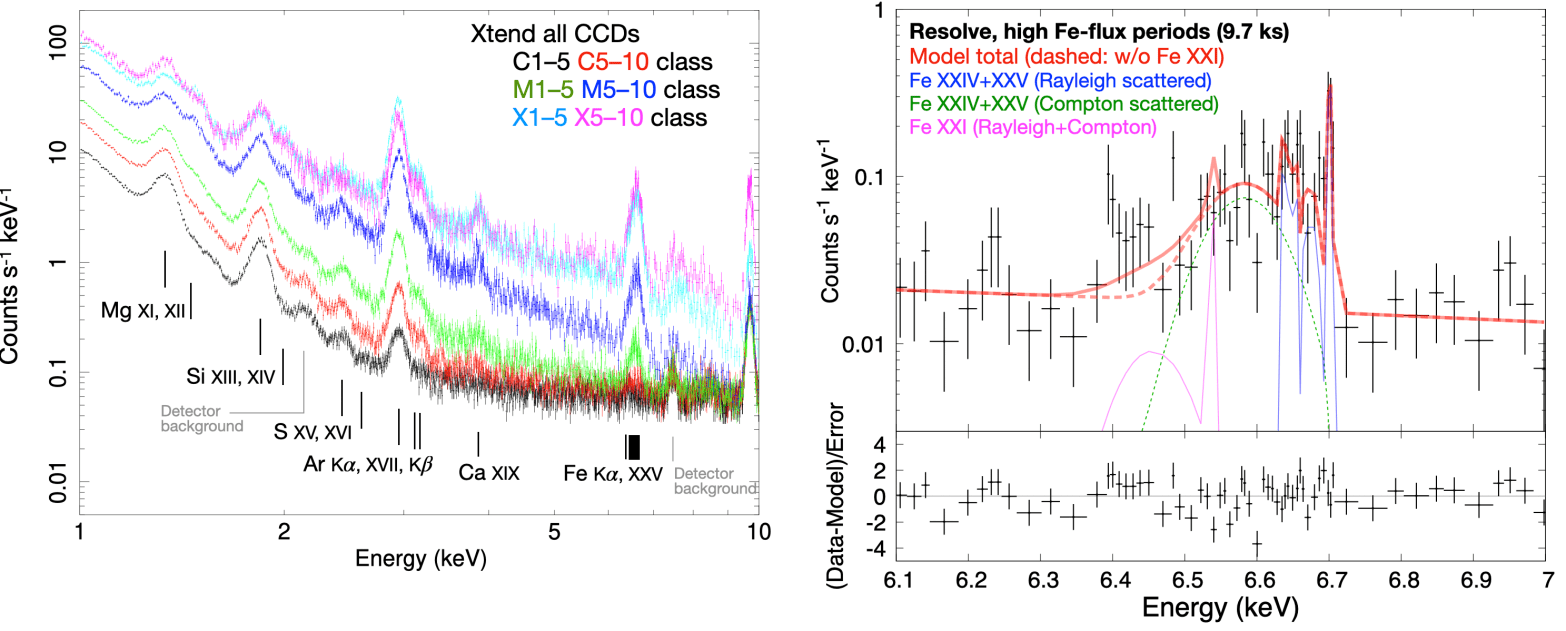
Our paper on the solar flare physics using the full performance of XRISM has been accepted for publication in PASJ (ADS). In its first ~2 years XRISM experienced a lot of solar flare events, which often made observable events in the detectors on XRISM. Although celestial observations are rarely affected, solar X-ray events are recorded during the periods when XRISM’s field-of-view is covered by the day-side of the Earth. The solar X-rays are reflected in the Earth’s atmosphere and sometimes reach XRISM, thereby making events in the detectors even though XRISM cannot directly look at the Sun.
In this work, we measured metal abundances during flare events using the imager “Xtend”, and obtained a high-resolution Fe-K line structure with the spectrometer Resolve for the first time since 1990s. The ~6.4 keV line, which with the statistics at this stage is only marginally detected, should provide unique insight into the physics of solar/stellar flare mechanisms. Hoping for future high-statistics data.
 Astrophysical Research Works of Hiromasa Suzuki