
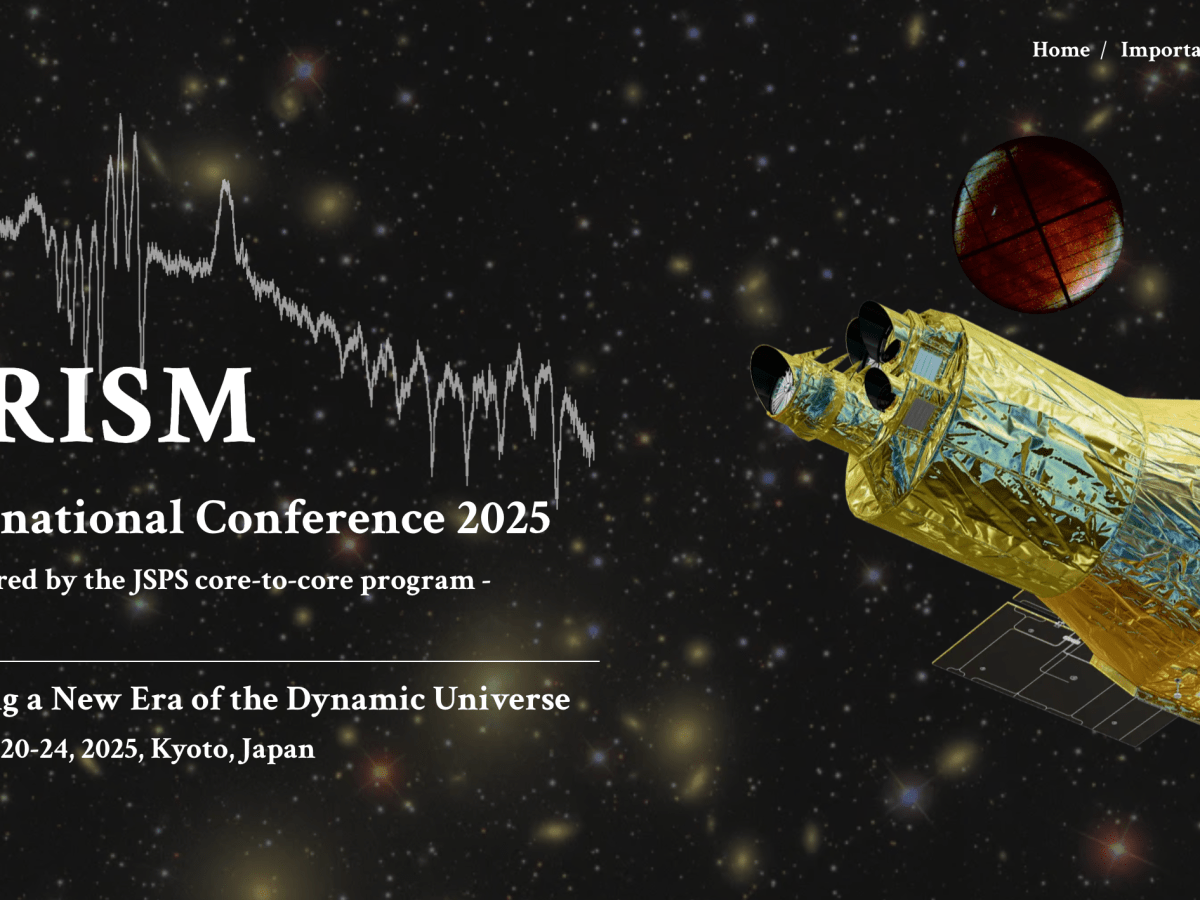
XRISM international conference 2025 @Kyoto
A conference to showcase the XRISM’s performance and scientific results, and to discuss the future, has been held in Kyoto, Japan on Oct. 20–24 (XRISM 2025). It was an excellent experience to be there and to give a review talk on the plasma physics of supernova remnants. Many authorities in astronomy and astrophysics were there…

XRISM solar flare paper
Our paper on the solar flare physics using the full performance of XRISM has been accepted for publication in PASJ (ADS). In its first ~2 years XRISM experienced a lot of solar flare events, which often made observable events in the detectors on XRISM. Although celestial observations are rarely affected, solar X-ray events are recorded…

Multi-wavelength study of a TeV-unidentified source near a supernova remnant
We studied a TeV source without clear counterparts in other wavelengths but close to the supernova remnant G335.2+0.1 (Oka et al. 2025, ApJ; ADS). We used radio continuum, radio lines, X-rays, and gamma-rays to understand what is going on in this interesting system. What was unique was, in this system, we can trace some physical…

XRISM science meeting #8 in Leiden
The last XRISM team meeting was held in Leiden, Netherlands early July, 2025. Leiden was a beautiful city. We reviewed what we have learned with XRISM and what we can do in the future, later phase. I was happy to see that really a lot of scientific results are coming out, covering a broad range…

17th IACHEC meeting in Osaka!
We held the 17th IACHEC meeting in Osaka, Japan. IACHEC is a consortium for international cross-calibration activities for X-ray detectors. More than 70 people attended from the US, Europe, China, Japan, etc. We are struggling to understand our own detectors by comparing own data with other detectors. Our recent major progress may include the understanding…

Moved to Miyazaki
My new institute from this April is the University of Miyazaki, located in the southern part of Japan. Miyazaki is famous for many historical sites related to the creation myth of Japan. Here I will continue my work on astrophysics but also would like to broaden research topics.
Highly efficient particle acceleration inferred in the supernova remnant N132D
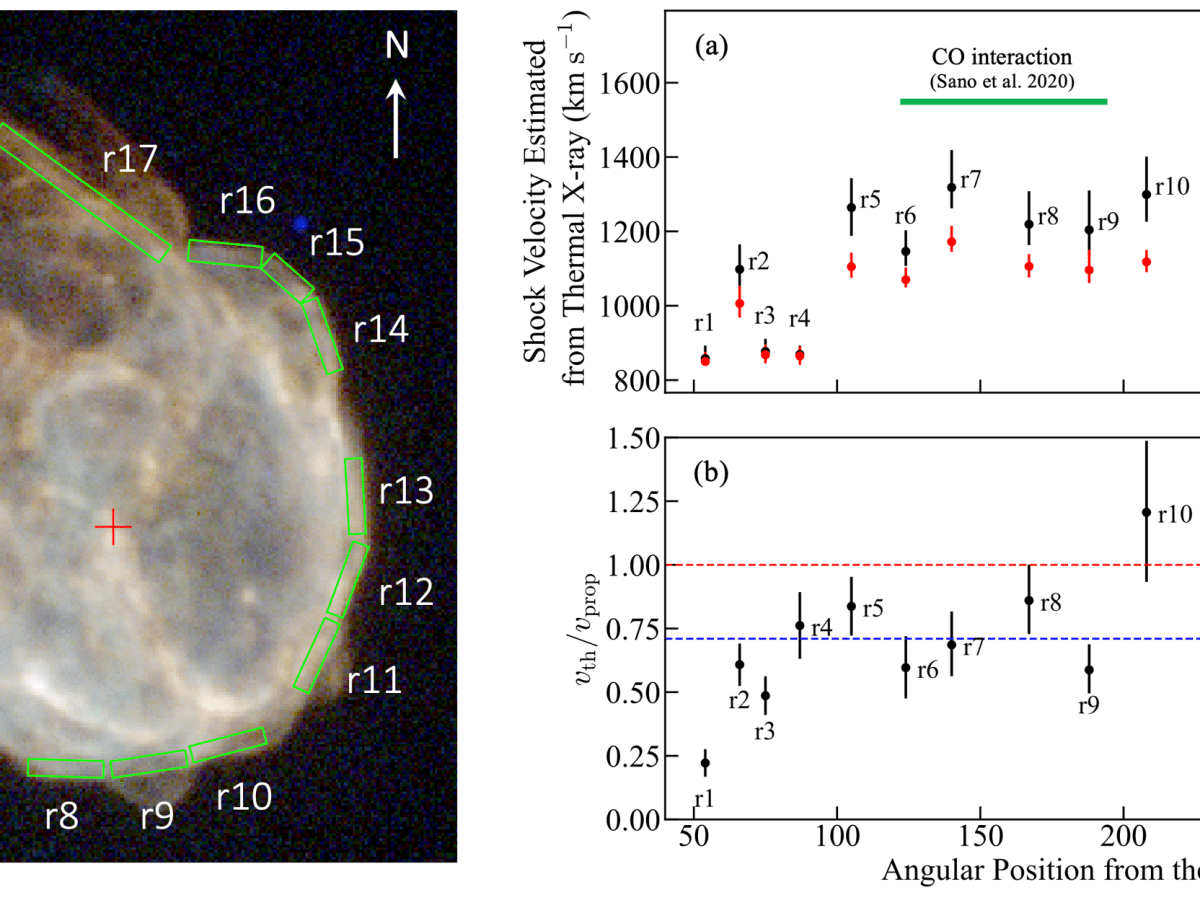
Based on thermal plasma emission, we have estimated the shock velocities which produced the hot plasma in N132D. The resultant velocities are generally lower than those directly measured by a proper motion measurement, partly reaching a factor of four discrepancy. This may suggest that a large fraction of the shock kinetic energy was transferred to…

XRISM science meeting #7 in Arizona
An internal team meeting of XRISM (SM7) has been held in Arizona, US. It was the best season for visitors and we had amazingly nice weather. Now that plenty of the science data have been collected, the entire XRISM team is working hard to publish bland new understanding of the universe. Every science team reported…

Detection of extended X-rays around microquasar V4641 Sgr with XRISM
Microquasar V4641 Sagitarii (Sgr) is now of great interest as an efficient cosmic-ray factory, because of the recent discovery of very high energy, extended gamma-ray emission around it with HAWC and LHAASO. Occasionally, XRISM observed this source on Sep 30 as a “generic ToO” target, following its recent outburst. The large field of view and…

XRISM Collaboration paper on the supernova remnant Sgr A East
Our XRISM paper on the supernova remnant Sagittarius A East (Sgr A East) has been accepted for publication in PASJ as a Letter (ADS). Sgr A East is a remnant located in a unique environment, the immediate vicinity (< a few pc) of the supermassive black hole of our Galaxy, Sgr A*. We are interested…

New non-equilibrium thermal plasma model
Our team, lead by Yuken Ohshiro (ISAS/JAXA), has developed an optically-thin thermal plasma model which calculates non-equilibrium temperature and ionization processes. The ApJ paper has been published (ADS). This is an updated version of the conventional XSPEC models (nei, rnei), where the electron temperature is assumed to be constant in time.

XRISM science meeting in Japan (SM6)
XRISM team members gathered at Tokyo Metropolitan University to share the latest status of the satellite operations, calibration, and scientific activities. We are still in the early phase of the mission, where the calibration and analysis software are not complete, and thus talking with people with various expertise is of great importance. It was so…
XRISM first paper on supernova remnant N132D!
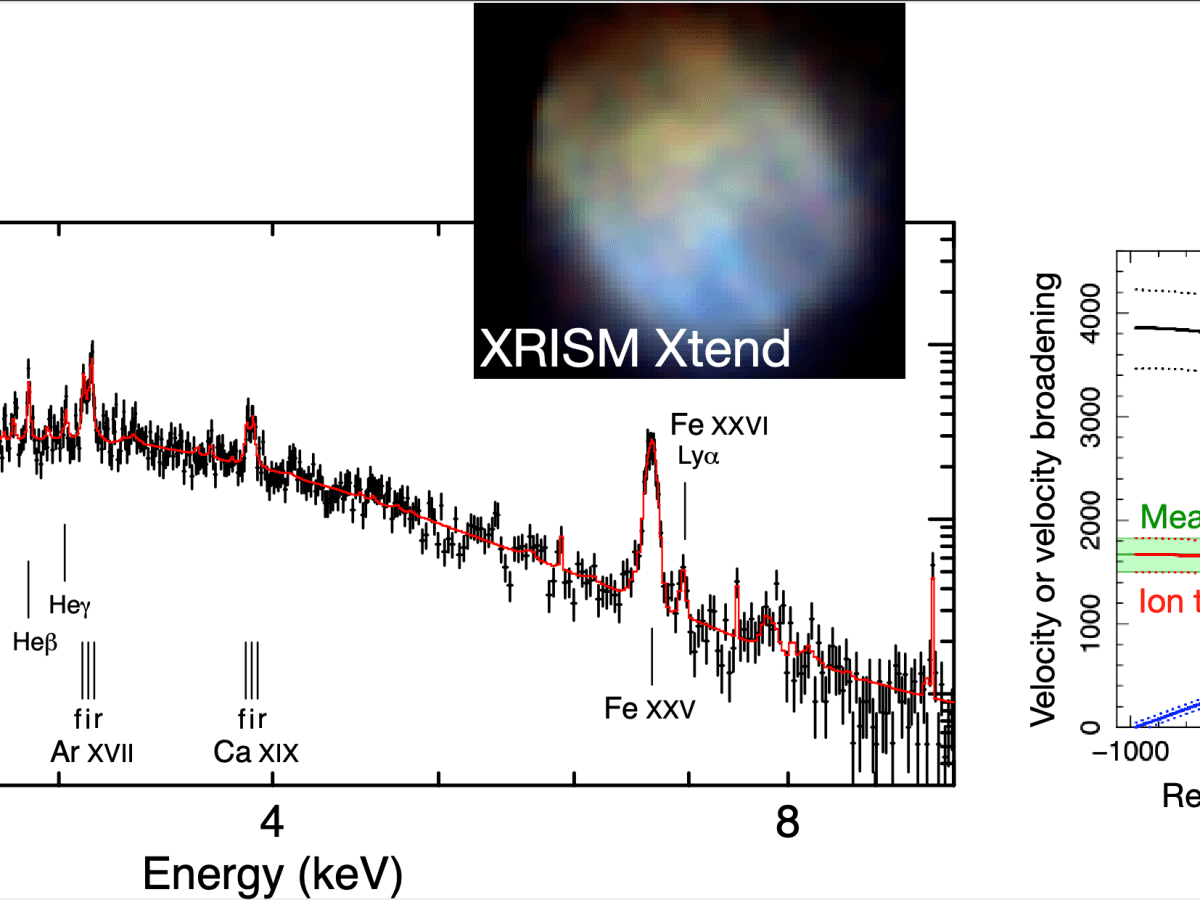
XRISM collaboration’s first paper on the LMC supernova remnant N132D has been accepted for publication in PASJ (ADS link). We successfully constrained the line widths and redshifts, and thereby confidently separated multiple temperature components. The narrow lines of Si, S, and Ar, and a broad Fe Hea triplet can be understood as due to different…

Fresh wind blows from historical supernova SN1181
Articles about our recent work on the remnant of SN1181 have been published based on our recent work (ADS). We put together our theoretical and observational efforts to understand the peculiar object IRAS 00500+6713. We propose that this object is the remnant of SN1181, which we believe was a type Iax supernova. (article in English…

Paper about initial operations of Soft X-ray Imager on XRISM
Our contribution to the SPIE 2024 proceedings, “Initial operations of the Soft X-ray Imager onboard XRISM” has been published (arXiv, SPIE). While scientific importance is not necessarily high, I hope this paper will work well as a summary of what and how we worked hard on in the commissioning phase of XRISM.

SPIE in Yokohama, Japan
This year’s SPIE conference was held in Yokohama, Japan. I gave a poster presentation about the initial operations of Soft X-ray Imager onboard XRISM. I met a lot of people working on detectors, optics, and satellite missions. In the field of the high energy astrophysics, latest attracting topics seem to include the China’s rapid growth…
Supernova remnant conference at Crete
I have attended the conference Supernova Remnants III: An Odyssey in Space after Stellar death held at Crete, Greece, in this June. I gave a poster presentation about our recent paper on decelerating X-ray knots and rims of RCW 103. I remember attending the “Supernova Remnants II” held at the same place in 2019. I…

IACHEC 2024 in Spain
I had a presentation and a lot of discussion at the 16th IACHEC meeting at Parador de La Granja (Spain). Cross-calibration of X-ray missions are of increasing importance with the emergence of new instruments including XRISM and fast-evolving Chinese missions.
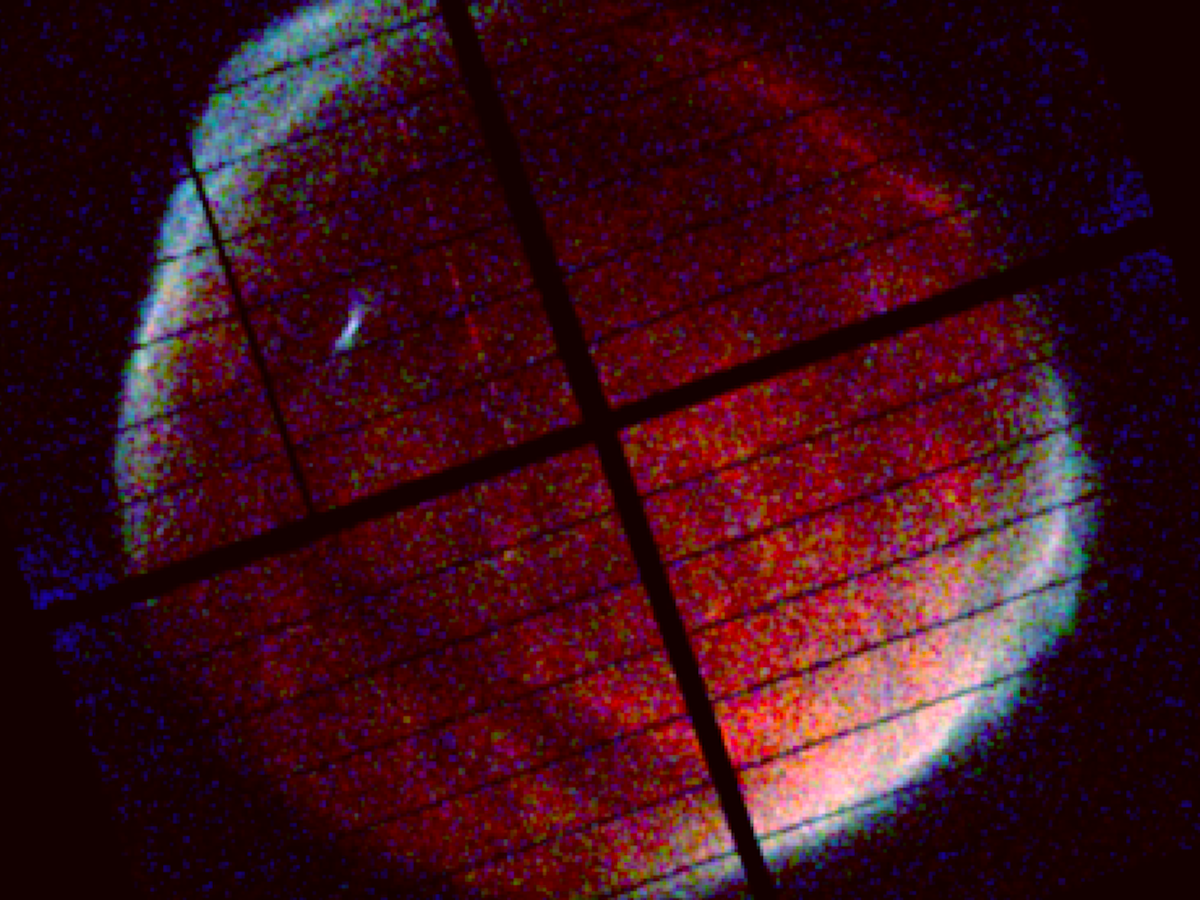
SN1006 with Xtend/XRISM
The CCD camera Xtend on XRISM observed SN1006. Thanks to its large field of view of 38×38 arcmin, entire emission of SN1006 was covered with one pointing. The image is really amazing. (Image credit: JAXA)

XRISM workshop in Geneva
I gave a presentation on XRISM/Xtend’s in-orbit performance at the XRISM workshop held in Geneva in Feb 12–14. Many young scientists were there, hoping to produce wonderful scientific results with XRISM.
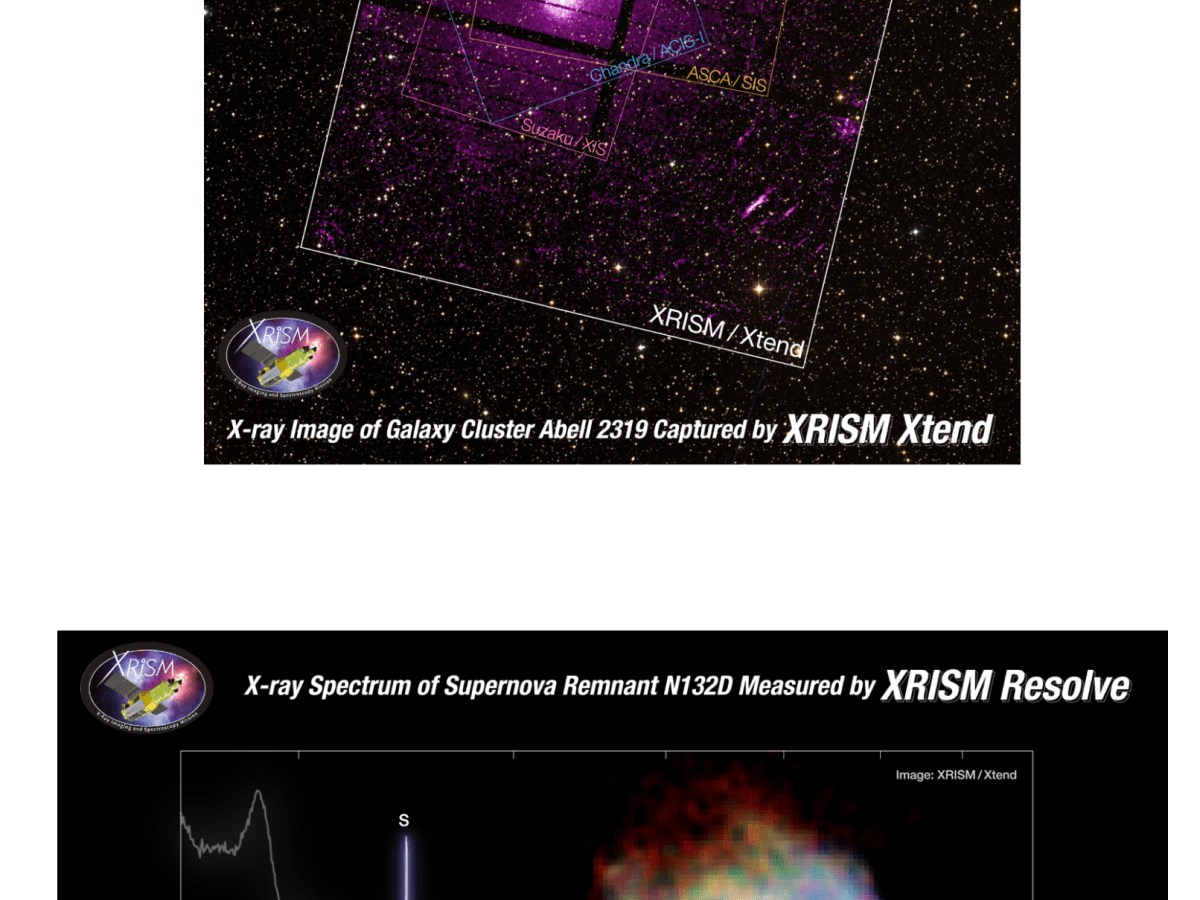
XRISM’s first light
Images & spectra from the XRISM’s first light observations have been published! Excellent spectral performance of Resolve and large field-of-view imaging capability of Xtend have been verified. Now we are preparing for huge tasks for scientific publications. For details, visit the JAXA’s official webpage.

XRISM is almost ready for observations!
Resolve and Xtend onboard XRISM have been turned on and are now almost ready for observations. Recent post from the XRISM X (Twitter) account.

Very recent shock reflection in the supernova remnant RCW 103 ?
Our paper on the discovery of global shock deceleration and reflection in the supernova remnant RCW 103 has been accepted for publication in ApJ. (arxiv link)We found that X-ray rims and knots largely changed their speeds and directions of motion in this 20 years, although the age of the remnant is thought to be greater…

Successful launch of XRISM
The X-ray astronomical satellite XRISM has been launched from the Tanegashima Space Center, Japan at 8:42 AM, Sep 7, 2023. The launch was successful without any problems, and the initial operation is going on. Hope to see wonderful data…! Image credit: MHI

Moved to ISAS/JAXA
I have moved from Konan University to ISAS (Institute of Space and Astronautical Science) of JAXA (Japan Aerospace Exploration Agency), which is located in Fuchinobe, Kanagawa. ISAS is the headquarter of space missions including the XRISM X-ray satellite.
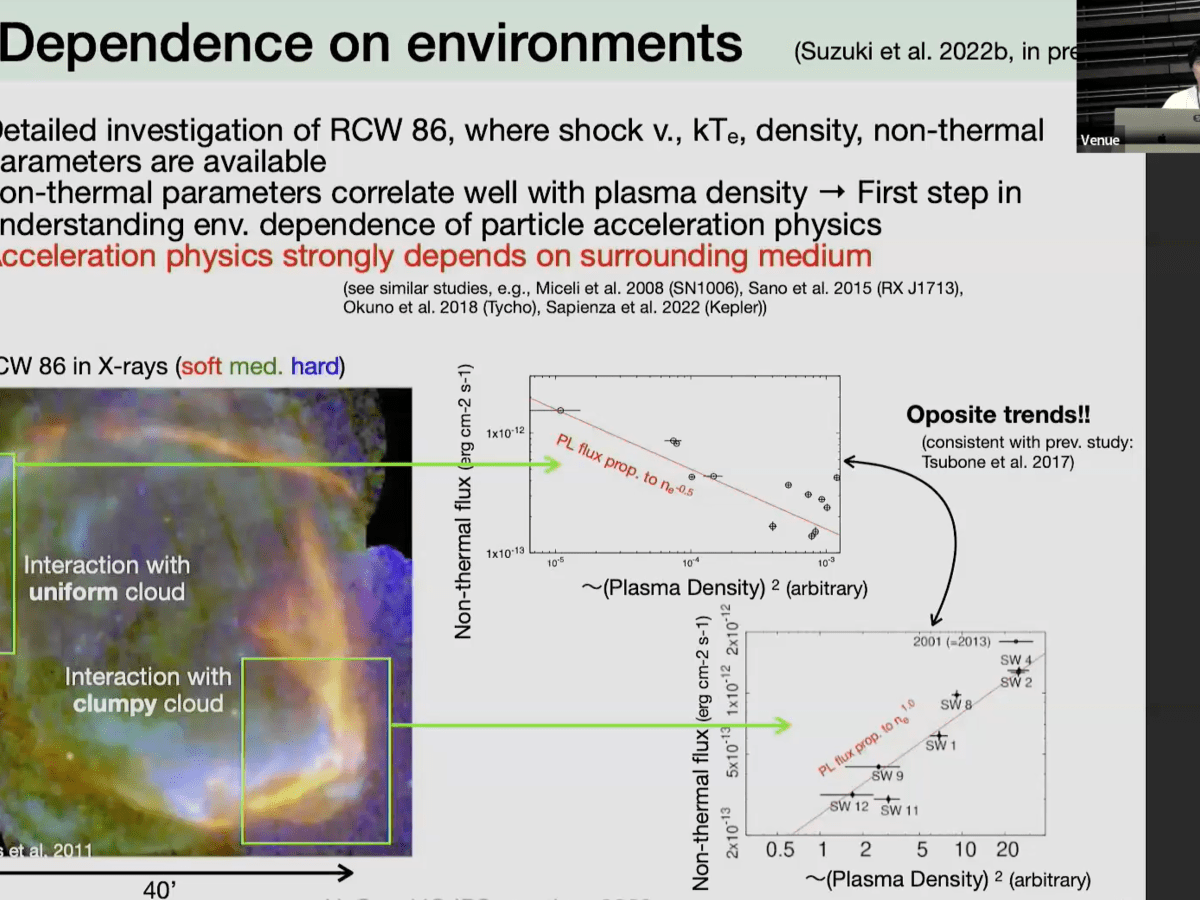
Presentation at APRIM 2023 in Fukushima
I gave a talk at APRIM2023 about systematic trends and variety of particle acceleration processes in supernova remnants (almost the same as that for ICRC 2023). I am glad that I can give a presentation in my hometown!

Presentation at ICRC 2023 in Nagoya
I gave a presentation at the ICRC2023, which was held at Nagoya University. The talk was about systematic trends and variety of particle acceleration processes in supernova remnants. The proceeding is available here.
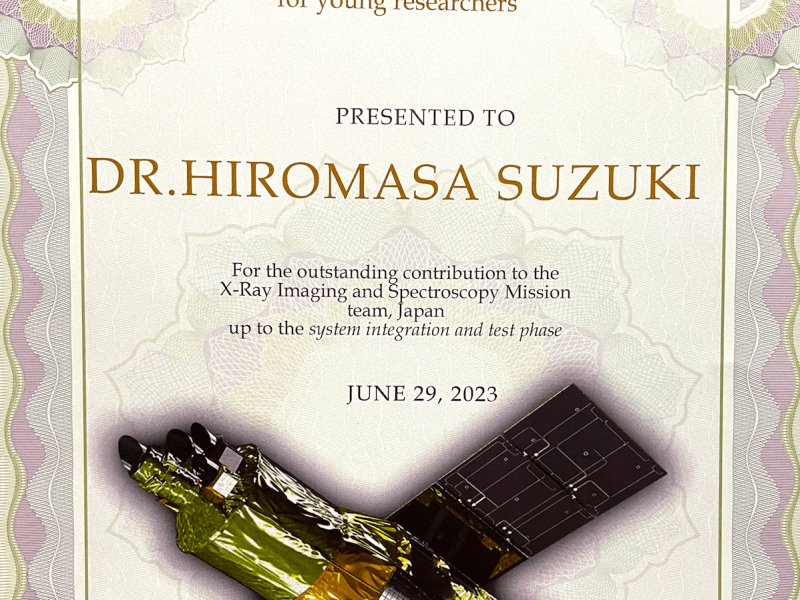
XRISM young researcher award
I was awarded the XRISM outstanding contribution award for young researchers for my contribution to the CCD team (Xtend). My primary contribution is the management/verification of operation procedures. After the launch, I will manage the detector calibration as well in collaboration with other X-ray satellites in the world.
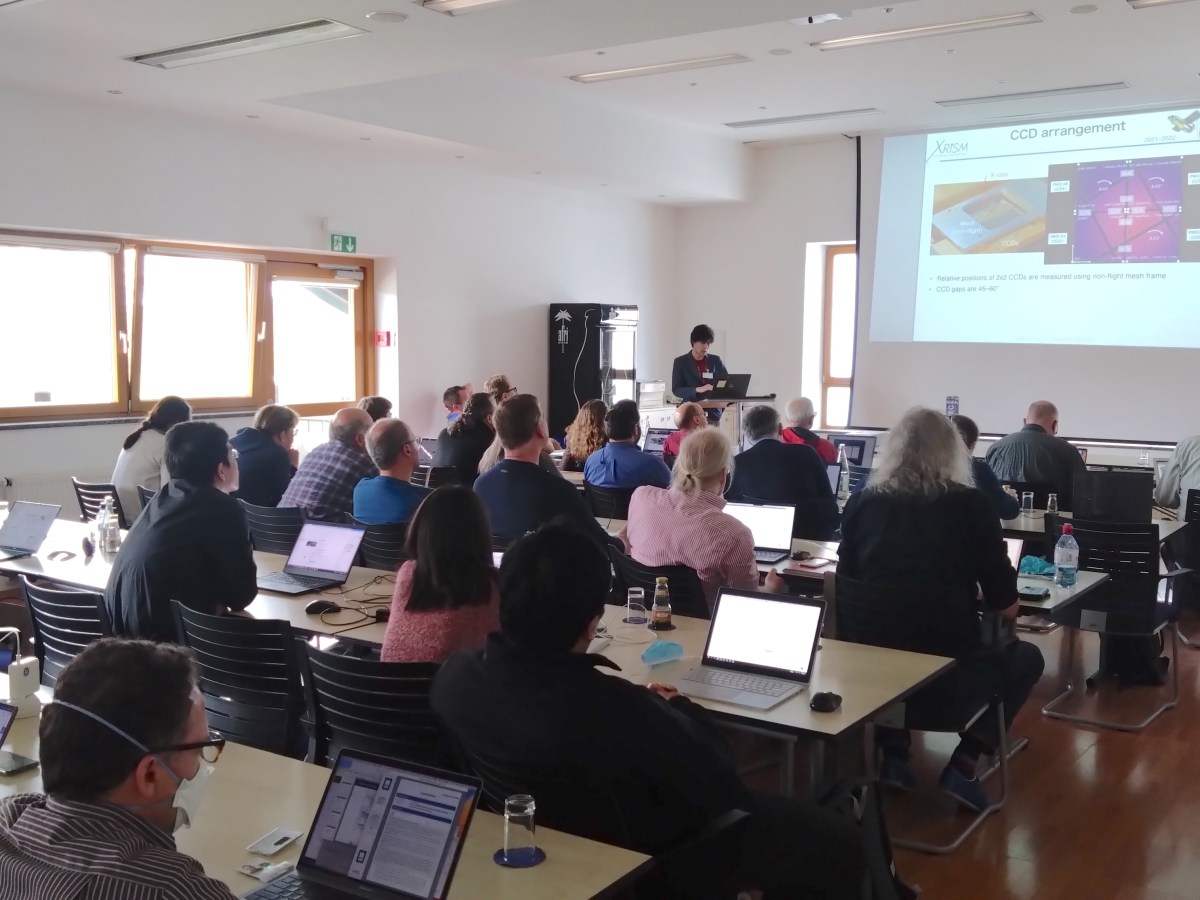
Presentation on ground calibration processes of Xtend/XRISM at the IACHEC 2023
I gave a presentation on the on-ground calibration processes of Xtend for XRISM at IACHEC 2023 held in Germany on 23-27 April 2023. Exchanging ideas of experiments, analysis techniques, and future missions, is important and fun. These people are behind-the-scenes supporters of the X-ray astrophysics.

Spacecraft test at the launch site on Tanegashima
I have attended a XRISM spacecraft test after it was shipped to the Tanegashima island, where the launch site is located. We confirmed the performance of Xtend. This will be the final detailed test before the launch.
 Astrophysical Research Works of Hiromasa Suzuki